

Short answer: Use international supplier platforms to test products cheaply, then move proven sellers to a local UAE wholesaler or your own small stock with a fulfilment company for fast delivery. Before you sell, order samples to a UAE address, test the product and the supplier’s replies, and agree prices, processing times and returns in writing.
When a dropshipping store fails in the UAE, the advertising usually gets the blame. Look closer and the real cause is often the supplier: parcels that took too long, products that looked different from the photos, or a supplier who stopped replying when something went wrong. Your customer never sees your supplier, but they feel every one of its decisions.
This article is about choosing that partner well. It compares the main types of supplier available to a UAE store, explains how delivery speed changes everything here, and gives you a practical way to vet a supplier before your money and reputation depend on it.
Why delivery speed matters so much here
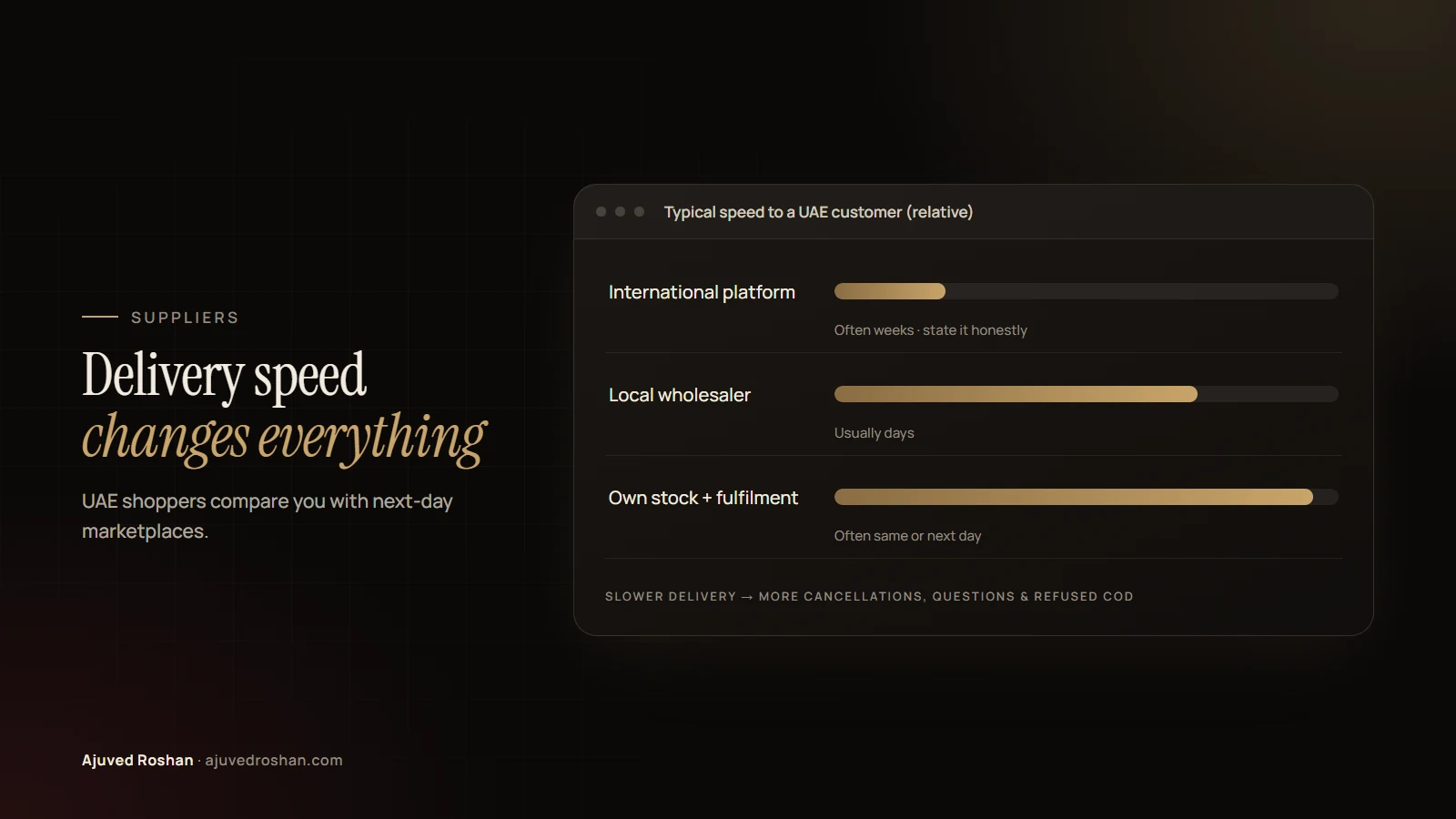
Shoppers in the UAE are used to fast delivery. The big marketplaces have trained them to expect parcels within a day or two, sometimes the same day. That doesn’t mean every product must arrive tomorrow, but it does mean that a long wait needs a good reason, such as a product they can’t find anywhere else, and it must be stated honestly before they pay.
Delivery time also affects your costs in ways that aren’t obvious at first. The longer an order takes, the more customers message to ask where it is, the more cancel, and, with cash on delivery, the more refuse the parcel when it finally arrives because they’ve changed their mind or bought it elsewhere. A cheaper supplier with slow shipping can easily cost you more in the end.
The main types of supplier
International supplier platforms
Global platforms such as AliExpress and dedicated dropshipping services such as CJdropshipping connect you to thousands of manufacturers and agents, mostly in China. They plug into Shopify with apps that import products and pass orders automatically, which makes them the easiest place to start testing.
The weaknesses are delivery time, inconsistent quality between sellers, and packaging you don’t control. Some platforms offer faster shipping lines or warehouses in other regions, so check exactly what they offer for UAE addresses rather than relying on the headline promise. Use these suppliers to test demand, not as your long-term setup for products that sell well.
Local wholesalers and distributors
The UAE is a major trading hub, and many wholesalers here sell everything from electronics accessories to home goods. Wholesale areas such as Dragon Mart in Dubai and the trading districts of Deira and Sharjah are full of them, and many now sell online too. Some will agree to dropship single orders to your customers, especially if you can show them a real store and a plan.
Local supply means faster delivery, easier returns and the chance to see and test the product in person. In exchange you’ll usually need to negotiate, you may face minimum monthly volumes, and you’ll have to check that the supplier’s products meet UAE requirements, such as registration for cosmetics or approval for wireless electronics.
Your own small stock with a fulfilment company
Once a product is selling, you can buy a small batch, import it, and keep it with a UAE fulfilment company. They store it, pick and pack each order, hand it to a courier, and often collect cash on delivery for you. Technically this isn’t pure dropshipping anymore, but it’s how many successful UAE stores operate: test with international suppliers, then move winners to local stock.
This model gives you the delivery speed of the marketplaces, your own branded packaging, and much better control over quality. The risk is that you now own stock, so only do it for products with proven, steady sales.
Print on demand and custom products
If your idea is branded clothing, mugs, phone cases or wall art, print-on-demand services make each item only after it’s ordered. Global services work, but delivery to the UAE can be slow. Local printers in the UAE can often produce small runs quickly, which is worth exploring if your designs have a loyal audience.
How the options compare
| International platform | Local wholesaler | Own stock + fulfilment | |
|---|---|---|---|
| Delivery to customer | Slowest | Fast | Fastest |
| Upfront cost | Lowest | Low to medium | Highest |
| Quality control | Hard | Good: you can inspect | Best |
| Returns | Difficult | Easier | Easiest |
| Branding & packaging | Very limited | Sometimes | Full control |
| Best for | Testing products | Steady products, local demand | Proven best sellers |
How to vet a supplier before you sell
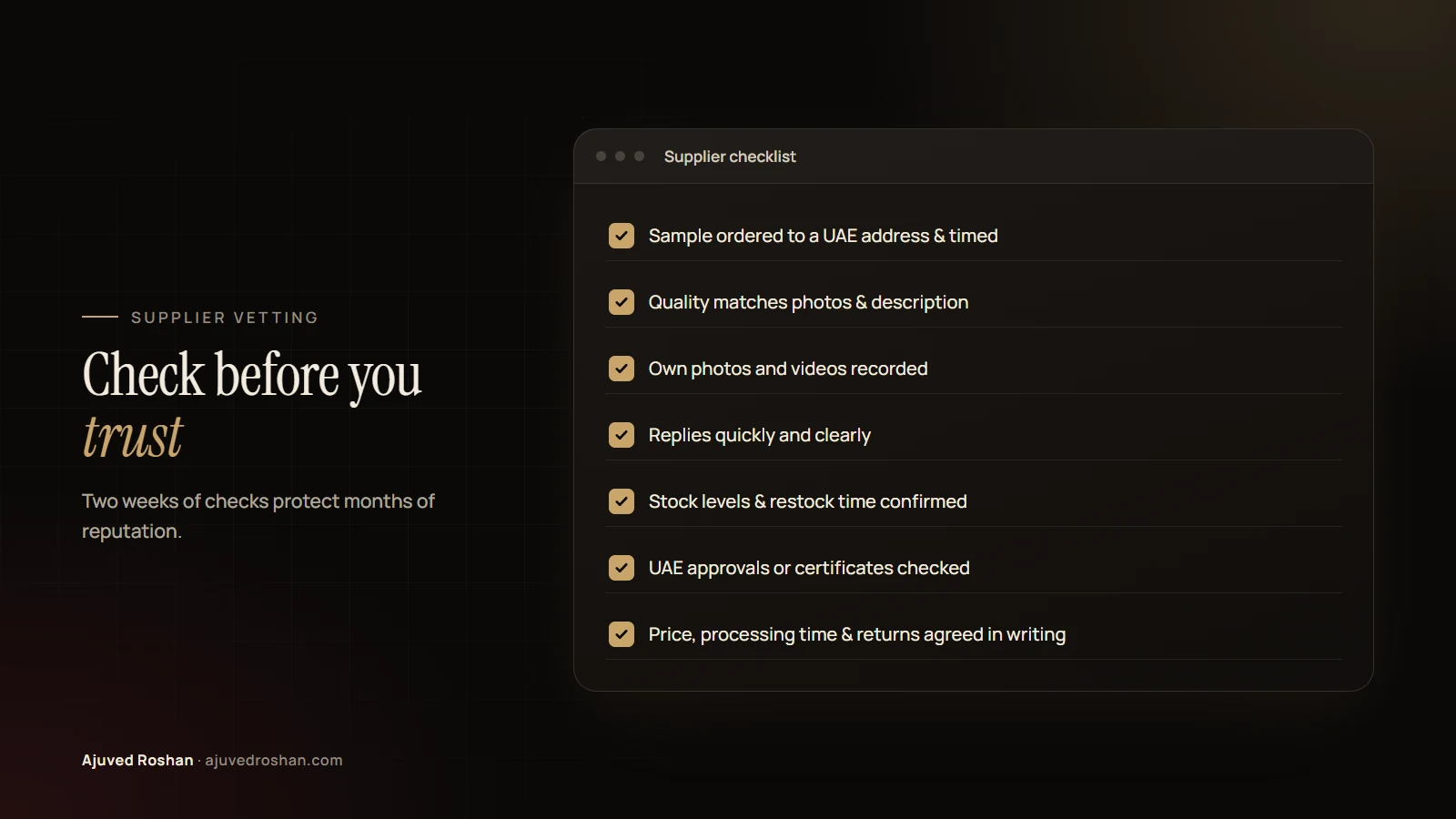
Whatever type of supplier you choose, run the same checks before you put their product in front of a single paying customer. It takes a week or two, and it’s the cheapest insurance you’ll ever buy.
Order samples to a UAE address. Pay for them like a customer would and time how long they take, door to door. Look at the packaging and the condition the product arrives in, because that’s what your customer will see. If the sample is late or damaged, assume your customers’ orders will be too.
Test the product properly. Use it for a few days. Compare it with the photos and description you plan to use. Take your own photos and short videos while you have it, because real footage converts far better than the supplier’s stock images and protects you from listing claims you can’t back up.
Test the communication. Send the supplier a question at an awkward time and see how long they take to reply, and how clearly. Ask what happens when a parcel is lost, a product arrives broken or a customer wants a different size. A supplier who is vague now will be unreachable later.
Check stock and consistency. Ask how much stock they hold and how quickly they restock. A winning product is useless if the supplier sells out the week your advert takes off. For international platforms, check that the same seller has been listing the product for a while with consistent reviews.
Check UAE requirements. Confirm the product can legally be sold here without extra approval, or that the supplier already has it. Ask for certificates where they apply. If a supplier claims a product is registered, ask for proof.
Agree the details in writing. Price per unit, shipping cost, processing time, how orders are passed to them, how you’re notified of tracking numbers, and the returns and defects process. Even a simple email confirmation is better than nothing.
Red flags
Be wary of a supplier who won’t send samples, insists on large upfront payments before a relationship exists, gives different answers to the same question, or offers prices that are far below everyone else’s. Be equally wary of product listings that use photos of a famous brand, or that make medical or safety claims. If something feels off at the start, it rarely improves once money is involved.
Connecting the supplier to your store
How orders get from your store to the supplier matters more than people think. International platforms usually have Shopify apps that pass orders and tracking numbers automatically. Local suppliers may prefer an email, a shared spreadsheet or a WhatsApp message per order, which works at the start but becomes risky as volume grows.
Whatever the method, make sure every order is sent the same day, every tracking number makes it back to the customer, and you have a simple daily check for orders that haven’t shipped. Most customer complaints start with an order that quietly sat unprocessed for two days.
Next, read how to find and test winning products for the UAE and how to sell with cash on delivery without losing money. If you haven’t sorted your licence yet, start with the licence options for UAE dropshippers.
I build Shopify stores connected to supplier apps, UAE couriers and fulfilment companies, so orders flow without copy and paste.
Frequently asked questions
Should I use international or local dropshipping suppliers?
Start with international platforms to test demand cheaply, but expect slower delivery and less quality control. Local wholesalers, or your own stock with a fulfilment company, deliver faster and make returns easier, so move winning products there.
How do I check a dropshipping supplier before selling?
Order samples to a UAE address and time the delivery, use the product for a few days, see how quickly and clearly the supplier replies, check stock levels, confirm UAE requirements and agree the terms in writing.
What are the warning signs of a bad supplier?
Refusing to send samples, asking for large upfront payments before any relationship, giving different answers to the same question, prices far below everyone else’s, and listings that use famous-brand photos or make medical or safety claims.
Why does delivery speed matter so much in the UAE?
Shoppers are used to next-day delivery from the big marketplaces. Slow delivery brings more ‘where is my order’ messages, more cancellations and, with cash on delivery, more refused parcels.
Sources and further reading
Want help planning your supply and delivery setup before you launch? Message me on WhatsApp or send a project enquiry. I reply within one working day.