
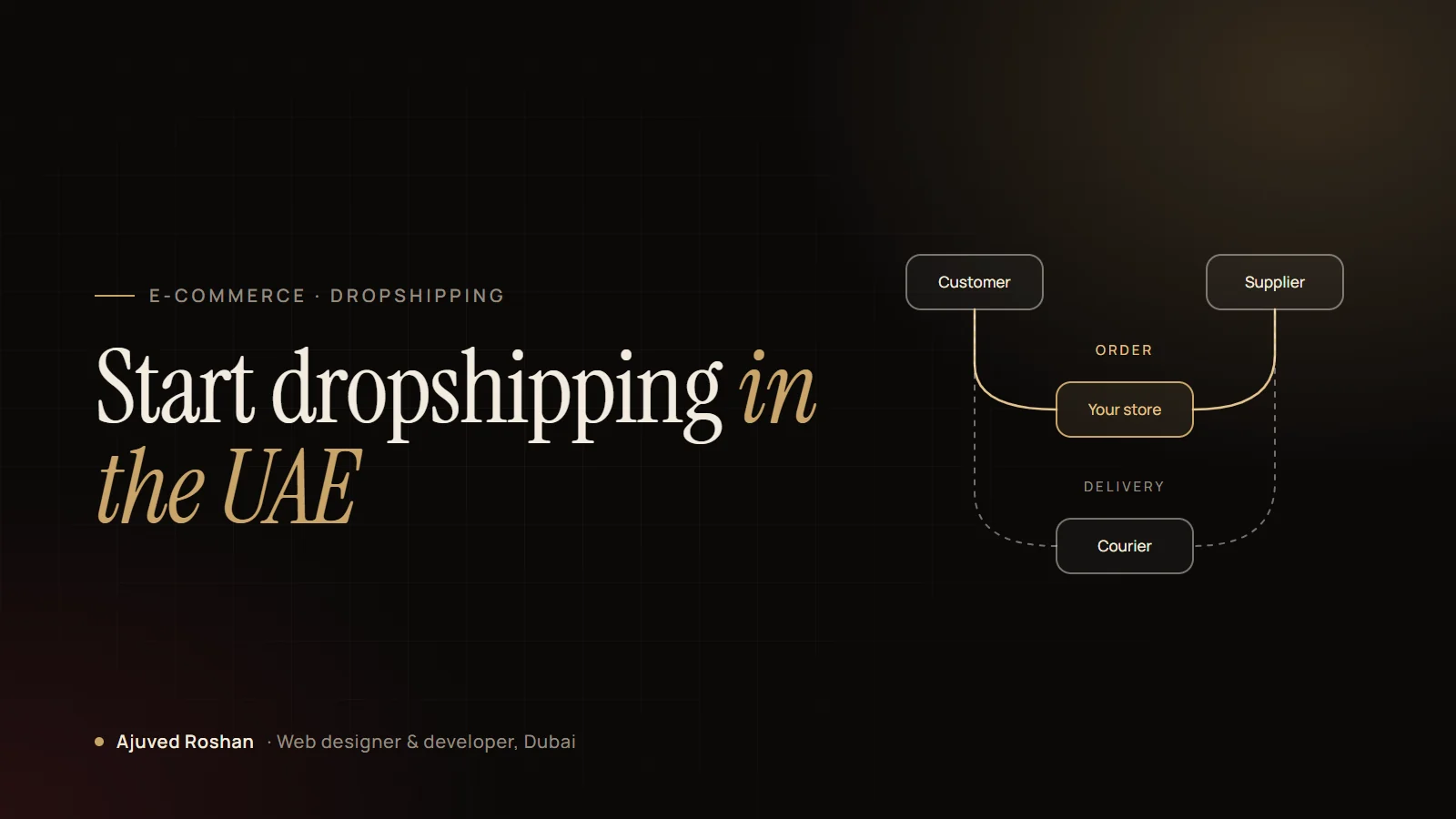
Short answer: To start dropshipping in the UAE, get a trade licence that covers online selling, choose fast suppliers (test overseas, then hold a small local stock of best sellers), build a trustworthy mobile-first store, offer cards plus cash on delivery, and work out your break-even cost per order before you spend on ads.
Every week I speak to someone in Dubai, Sharjah or Abu Dhabi who wants to start an online store. Most of them have a job, a small budget and a product idea, and almost all of them have watched videos promising that dropshipping is the fastest way to get started. Some of that is true. A lot of it was made for the United States or Europe and doesn’t survive contact with the UAE market.
This guide is the conversation I have with those people. It covers how dropshipping actually works here, what you need to set up before you sell, where the real costs and risks sit, and how to get your first orders without burning your budget. It’s long because the details matter. If you only remember one thing, remember this: in the UAE, delivery speed and trust decide whether a store survives, far more than the product you pick.
What dropshipping is, in plain terms
In a normal shop you buy stock, store it, and send it out when someone orders. In dropshipping you never hold the stock. You list products on your own website, a customer pays you, and you pass the order to a supplier who packs and ships it directly to the customer. You keep the difference between what the customer paid and what the supplier charged you, minus your costs.
That sounds simple, and the mechanics are. What makes it a business is everything around the mechanics: choosing products people actually want, presenting them in a way that earns trust, getting them delivered quickly, handling the customer who wants to return something, and buying advertising at a price that still leaves you a profit.
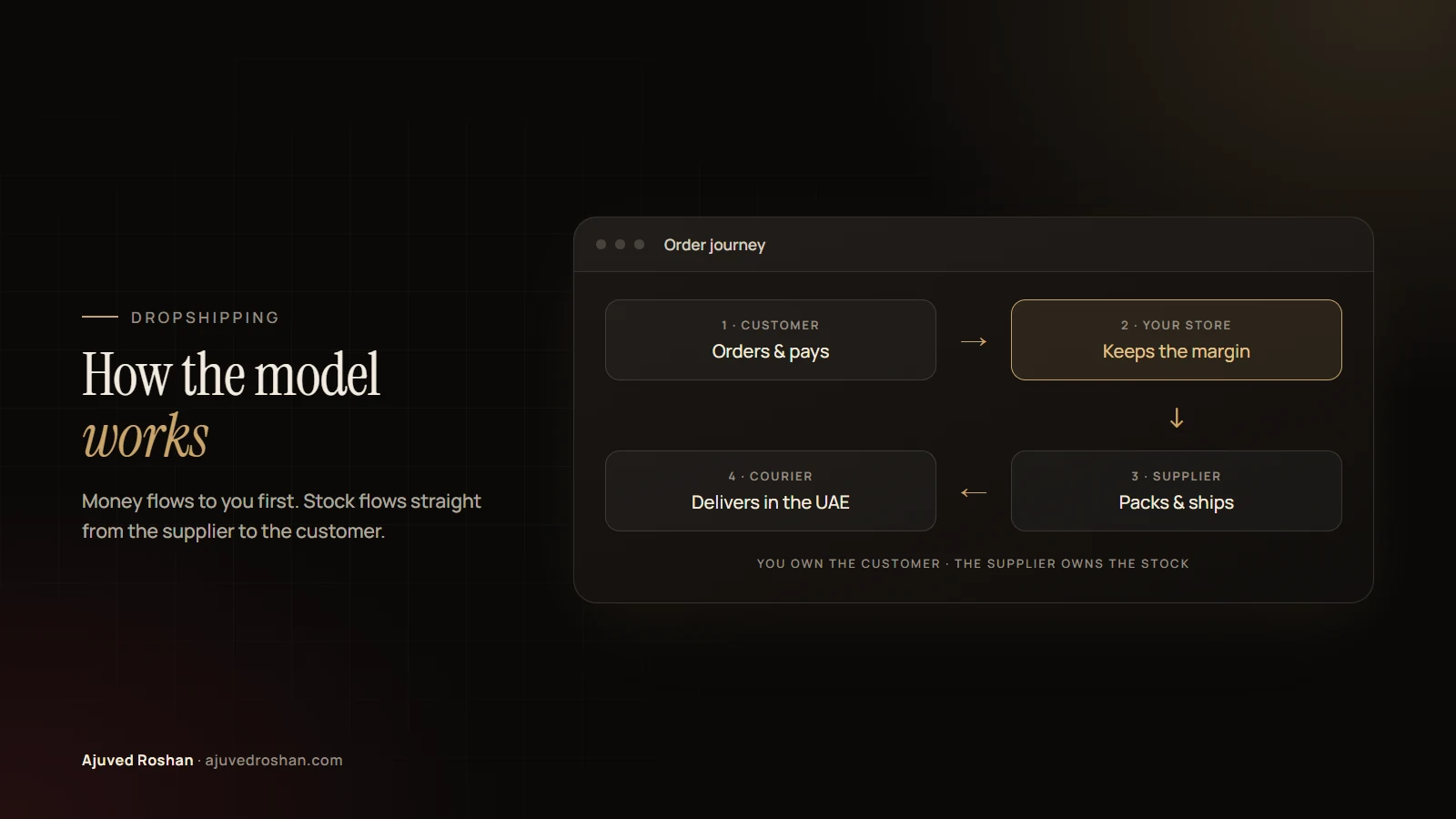
The diagram above is the whole model. Money flows from the customer to you, and from you to the supplier. The product flows from the supplier to the customer, ideally through a courier who can deliver quickly inside the UAE. You sit in the middle and own the customer relationship, which is the part that has value long term.
Why the UAE is different from the videos
Most dropshipping advice assumes a customer who will happily wait two or three weeks for a parcel from overseas and who pays by card. UAE shoppers are used to next-day and even same-day delivery from the big marketplaces. If your store says “ships in 12 to 20 days”, you are competing against Amazon.ae and noon with one hand tied behind your back.
The second difference is payment. Card payments and wallets like Apple Pay are very common, and buy now, pay later services such as Tabby and Tamara are popular. But cash on delivery is still something many shoppers look for, especially when they are buying from a store they’ve never heard of. COD builds trust, but it also brings refused parcels and slower cash flow, which I cover in detail in my guide to cash on delivery in the UAE.
The third difference is language and culture. Your customers may search and read in Arabic, English or both, and seasonal moments such as Ramadan, Eid, the Dubai Shopping Festival, White Friday and back-to-school shape what people buy and when. A store that is built for this market, not translated into it, converts better.
None of this makes dropshipping a bad idea in the UAE. It means the version that works here looks a little different: faster suppliers, a more trustworthy store, a mix of payment options and a stronger focus on the customer experience after the click.
Step 1: Set up the business properly
Selling online in the UAE is a commercial activity, and you need a licence that covers it. The good news is that there are several routes, including licences built for online and home-based sellers and e-commerce licences from free zones. The right one depends on your nationality and residency, whether you want a visa from the business, and whether you need to sell to customers across the mainland.
I’ve written a separate, detailed article on the licence options for dropshipping in the UAE, including VAT and corporate tax basics. Please read it before you spend money on advertising. A payment gateway will ask for your trade licence, and so will most couriers that offer cash on delivery, so the licence isn’t just a legal box to tick; it unlocks the tools you need to trade.
Step 2: Decide what kind of dropshipping you’ll do
There are really three models, and choosing between them is the most important decision you’ll make after the licence.
International dropshipping
This is the classic model: you list products from a global supplier platform and they ship from overseas. Start-up costs are the lowest and the product range is enormous. The trade-offs are longer delivery times, less control over packaging and quality, and returns that are awkward because sending something back overseas rarely makes sense. It can work for unique products that customers can’t easily find locally, but it struggles against the marketplaces on everyday items.
Local dropshipping
Here your supplier is a wholesaler or distributor inside the UAE who agrees to ship single orders to your customers. Delivery can be as fast as the marketplaces, returns are easier, and you can visit the supplier and see the stock. The catch is that fewer suppliers offer this, margins can be thinner, and you need to build the relationship yourself.
Hybrid: test overseas, then hold a small stock locally
This is the model I recommend to most people. You test products with a supplier that can ship to the UAE, and once a product proves itself, you bring a small batch into the country and keep it with a fulfilment company, or at home if your licence allows it. Your best sellers then arrive in a day or two, while you keep testing new products cheaply. My guide to finding dropshipping suppliers for the UAE goes through each option in depth.
Step 3: Choose products for this market
Products that work in the UAE usually solve a clear problem, look good on a phone screen, are light enough to ship cheaply, and aren’t easy to buy at the mall down the road. Climate matters: products for heat, sun, sand, cars and indoor living have a natural audience. So does the calendar, because gifting peaks around Eid, Ramadan, Mother’s Day and the end of the year.
There are also products you should avoid as a beginner. Anything that touches health, cosmetics, food supplements, children’s safety or wireless electronics may need registration or approval before it can be sold in the UAE, and anything that looks like a copy of a famous brand can get you into serious trouble. I’ve written a full method for finding and testing products in how to find winning dropshipping products for the UAE.
Step 4: Build a store people trust
A first-time visitor has never heard of you. In the few seconds before they decide to leave, your store has to answer three questions: is this a real business, will my order actually arrive, and what happens if something goes wrong? The stores that win answer those questions without the customer having to look.
That means a clean, fast, mobile-first design; real photos and short videos of the product, not just the supplier’s stock images; clear delivery times shown on the product page; a visible returns policy written in plain language; a WhatsApp button so people can ask a question before they buy; and an About page that shows there’s a person behind the brand. If you sell to Arabic-speaking customers, the Arabic version should be properly designed, not a machine translation squeezed into an English layout.
For most dropshippers I build on Shopify, because it handles hosting, security and checkout, and connects easily to supplier apps and UAE couriers. WooCommerce makes sense when you want more control or plan to publish a lot of content. I compare the two honestly in WordPress vs Shopify for UAE businesses, and my UAE online store checklist covers the pages and settings you need before launch.
Step 5: Payments and cash on delivery
You’ll want at least a card gateway with Apple Pay and Google Pay, and it’s worth considering a buy now, pay later option if your average order value is high enough. Add cash on delivery through your courier if your audience expects it, but treat it as a tool to manage, not a free extra. Confirming COD orders by WhatsApp before you ship, and asking for a small advance on high-value items, can save a lot of wasted deliveries.
When you apply for a gateway, expect to provide your trade licence, ID, bank details and a live website with clear policies. Gateways look closely at refund, delivery and privacy pages, so have them ready before you apply.
Step 6: Delivery and returns
If you hold any stock in the UAE, you can work with local couriers and fulfilment companies, many of which offer same-day or next-day delivery and cash collection. If your supplier ships from overseas, be honest about delivery times on every product page and in the order confirmation. A customer who knows a parcel will take ten days is patient. A customer who expected two days opens a dispute.
Imports also bring customs and VAT considerations. Dubai Customs updated its rules in 2026 so that goods valued up to AED 1,000 are exempt from customs duty, while VAT can still apply. Rules differ by emirate and change over time, so check the current position with your courier or customs broker rather than relying on a blog post, including this one.
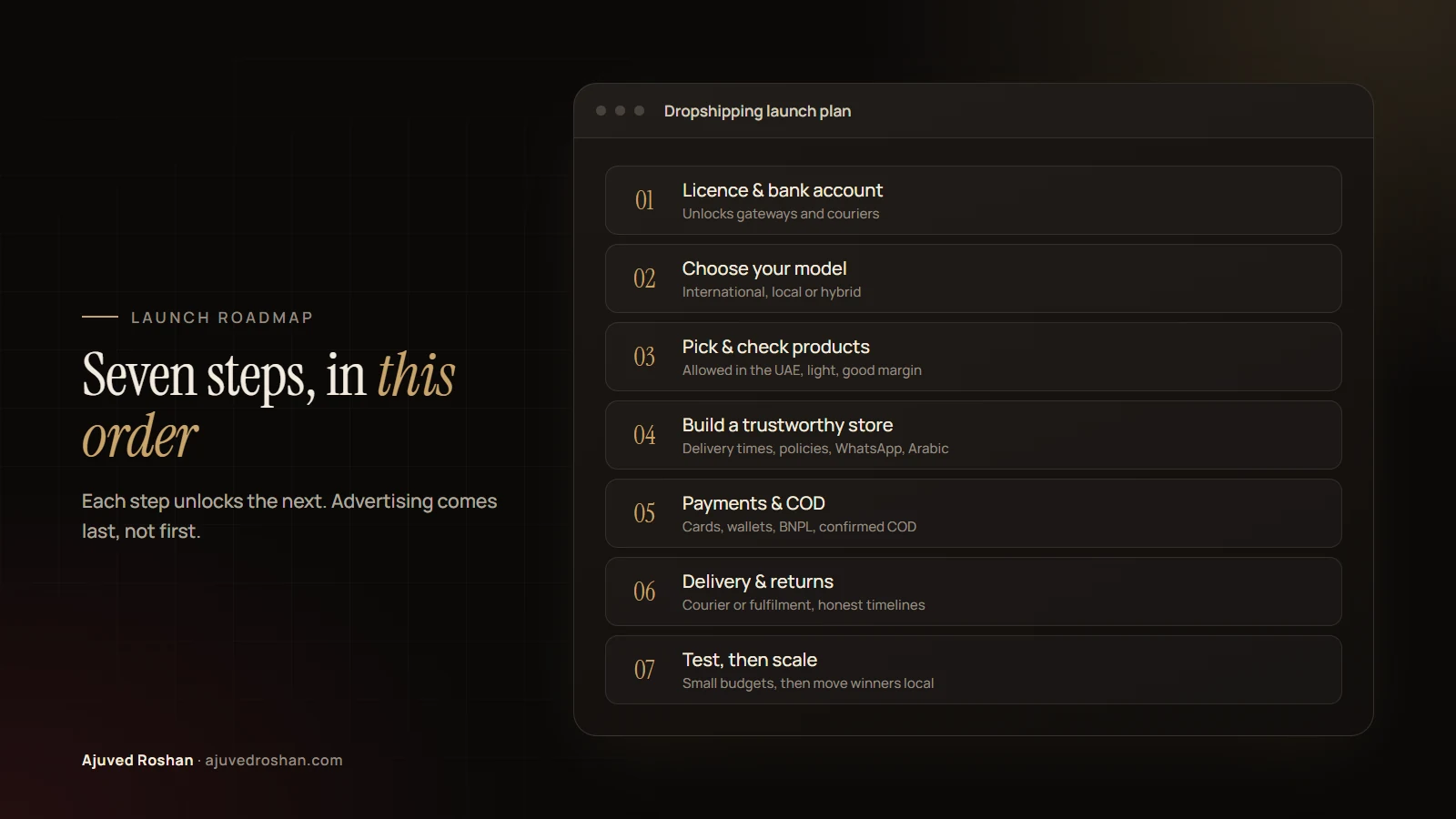
Step 7: Getting your first orders
Most UAE dropshipping stores get their first customers through paid social media: Instagram, TikTok and Snapchat, which is widely used across the Gulf. Short, honest videos that show the product solving a problem tend to beat polished adverts. Start with small daily budgets, test several videos for each product, and only increase spend on the combinations that bring orders at a cost you can afford.
Don’t ignore Google. People searching for a specific product are often closer to buying than people scrolling social media, and Google Shopping ads can show your product image and price right in the results. Over time, product pages and helpful articles can also bring free traffic from search, which lowers your cost per order.
Influencers can work well in the UAE, but be careful. Paid promotion is regulated, and content creators who advertise for payment are expected to hold a permit from the UAE Media Council. Ask to see it, agree in writing what you’re paying for, and track sales with a unique discount code.
The numbers you must understand before you start
I won’t give you made-up figures, because every product and niche is different. But you need to know the shape of your numbers before you advertise. For each product, write down the price the customer pays, the supplier’s price, shipping, payment fees, the cost of packaging or inserts, and an allowance for returns and refused COD orders. What’s left is your margin before advertising.
Then decide the most you can spend on advertising to win one order and still make a profit. That number, your break-even cost per order, is the single most important figure in a dropshipping business. If your ads can’t bring orders below it, the product doesn’t work, no matter how many likes the video gets.
| Cost line | What to include |
|---|---|
| Product cost | Supplier price for one unit, including any variant upcharges |
| Shipping | Supplier shipping or your courier’s rate, plus fulfilment fees if you use a warehouse |
| Payment fees | Gateway percentage and fixed fees, or the courier’s COD fee |
| Returns & refusals | An allowance for refunds, return shipping and parcels refused at the door |
| Tax | VAT if you’re registered, and your corporate tax position |
| Advertising | Your break-even cost per order: what’s left after everything above |
Mistakes I see again and again
The most common mistake is spending on advertising before the store is ready. If your product pages don’t show delivery times, your policies are missing, and the checkout hasn’t been tested on a phone, you’re paying to send people to a store that can’t convert them.
The second is choosing a product because it went viral somewhere else. Viral in the United States doesn’t mean viral in the UAE, and by the time you see a product everywhere, the advertising is usually expensive and the market crowded.
The third is ignoring customer service. In this market, a fast reply on WhatsApp is often the difference between a sale and an abandoned cart, and between a refund request and a happy repeat customer. Plan who will answer messages and how quickly before you launch.
And the fourth is treating dropshipping as passive income. It isn’t. It’s a real retail business with a different stock model. The people who succeed treat it that way: they test carefully, they look after customers, and they move their winners to faster, more reliable supply as soon as the numbers allow.
Where to go from here
If you’re serious about starting, read the rest of this series in order: the licence options, finding suppliers, finding and testing products and selling with cash on delivery. Together they cover the decisions that make or break a new UAE store.
When you’re ready to build, I design and develop e-commerce websites and Shopify stores for UAE businesses, set up properly for payments, COD, Arabic and fast delivery from day one.
Frequently asked questions
Do I need a licence to dropship in the UAE?
Yes. Selling online is a commercial activity, so you need a licence that covers it, such as a licence for online or home-based sellers or a free-zone e-commerce licence. Payment gateways and most cash-on-delivery couriers will ask to see it.
Which dropshipping model works best in the UAE?
For most people a hybrid: test products with a supplier that ships to the UAE, then keep a small stock of proven sellers with a local fulfilment company so they arrive in a day or two, like the big marketplaces.
Should I use Shopify or WooCommerce for dropshipping?
Shopify suits most dropshippers because it handles hosting, security and checkout and connects easily to supplier apps and UAE couriers. WooCommerce makes sense when you want more control or plan to publish a lot of content.
How much can I spend on ads to win one order?
No more than your break-even cost per order: the selling price minus product cost, shipping, payment fees, an allowance for returns and refused COD parcels, and tax. If your ads can’t bring orders below that, the product doesn’t work.
Sources and further reading
- Shopify: What is dropshipping and how does it work?
- UAE Federal Tax Authority: VAT
- UAE Federal Tax Authority: Corporate Tax
- Dubai Customs
- Tabby: buy now, pay later in the UAE
Planning a dropshipping store in the UAE and want an honest opinion on your idea? Message me on WhatsApp or send a project enquiry. I reply within one working day.