
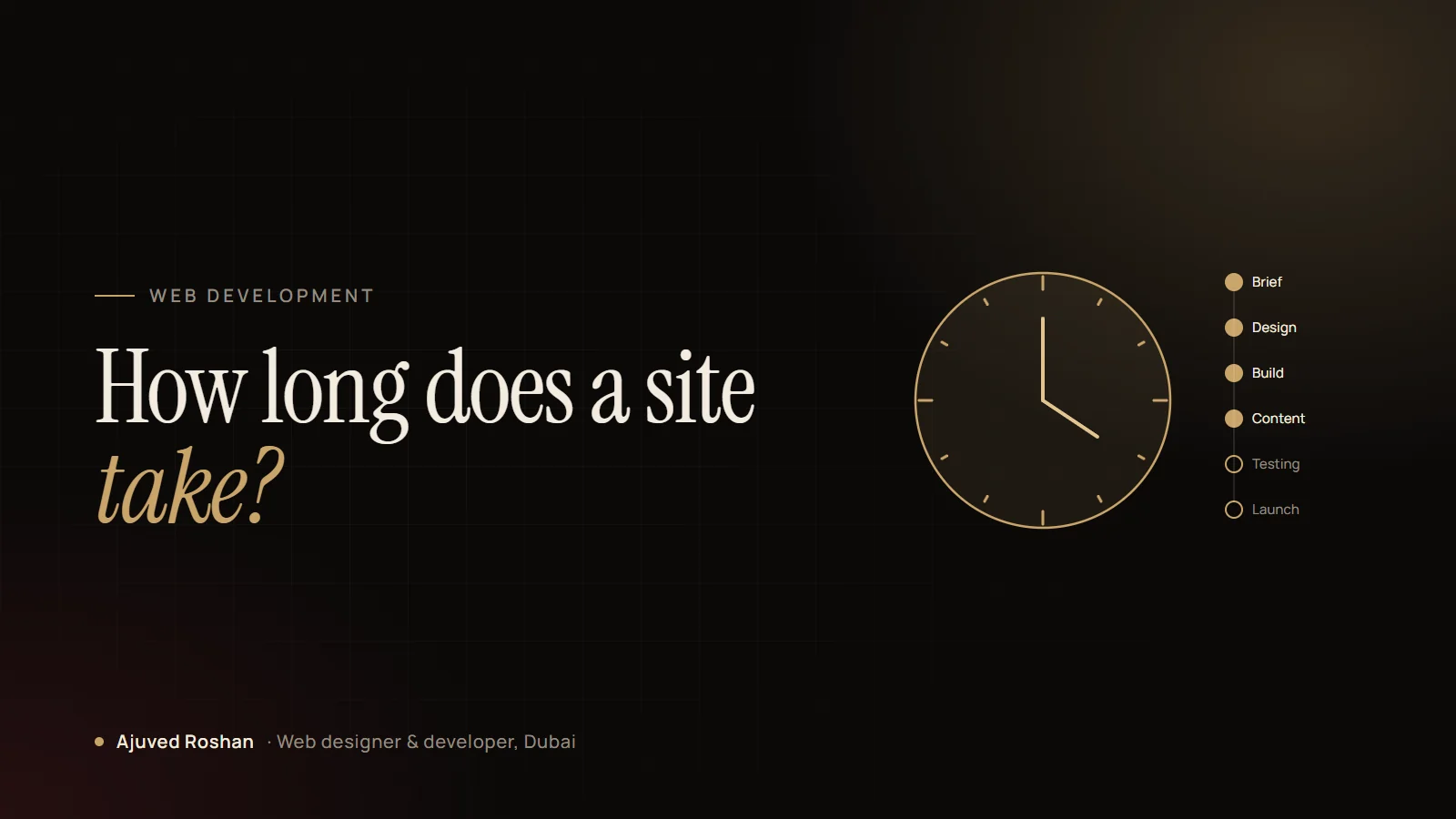
It’s one of the first questions in every project, and the honest answer is: it depends mostly on decisions and content, not on how fast the developer types. A small site can be ready quickly when everything is prepared. A bigger one can drag on for months when content and feedback are missing.
What decides the timeline
| Factor | Why it matters |
|---|---|
| Number of pages and templates | More unique layouts mean more design and build time |
| Content readiness | Waiting for text and photos is the most common delay |
| Custom features | Booking, integrations, calculators and portals add development and testing |
| Languages | A bilingual English and Arabic site needs translation and right-to-left checks |
| E-commerce | Products, payments, delivery rules and policies all need setting up |
| Feedback speed | Every week waiting for approval adds a week to the project |
| Number of decision-makers | More people to agree means more review rounds |
The typical stages
- Discovery and brief: goals, audience, pages, features and examples you like.
- Structure and content plan: a sitemap and what goes on each page.
- Design: the homepage and key templates, with a round or two of feedback.
- Development: building all pages, responsive layouts and features.
- Content: adding final text, images and SEO settings.
- Testing: phones, browsers, forms, speed, tracking.
- Launch: go live, redirects, Search Console, and a final check.
I describe each step in more detail in my website project from brief to launch.
Rough guide by project type
Every project is different, so treat these as relative sizes rather than promises:
- Single landing page: the fastest, especially with content ready.
- Small business site (5 to 10 pages): a short project when content and feedback are quick.
- Larger or bilingual site: longer, mainly because of content, translation and review.
- Online store or custom features: the longest, because of products, payments and testing.
Your developer should give you a timeline for your specific scope, with the dates that depend on you clearly marked.
How to keep your project on schedule
- Write a clear brief before you start. My website brief template helps.
- Prepare your text, logo and photos early, or agree who writes the content.
- Choose one person to collect feedback and give final approval.
- Give feedback in one consolidated list, within an agreed number of days.
- Avoid adding new features halfway through; save them for phase two.
Content and decisions set the pace of a website project far more than code.
Planning a website?
See how much a website costs in Dubai and my web development service, or browse recent projects.
Want a realistic timeline for your project? Message me on WhatsApp or send a project enquiry. I reply within one working day.